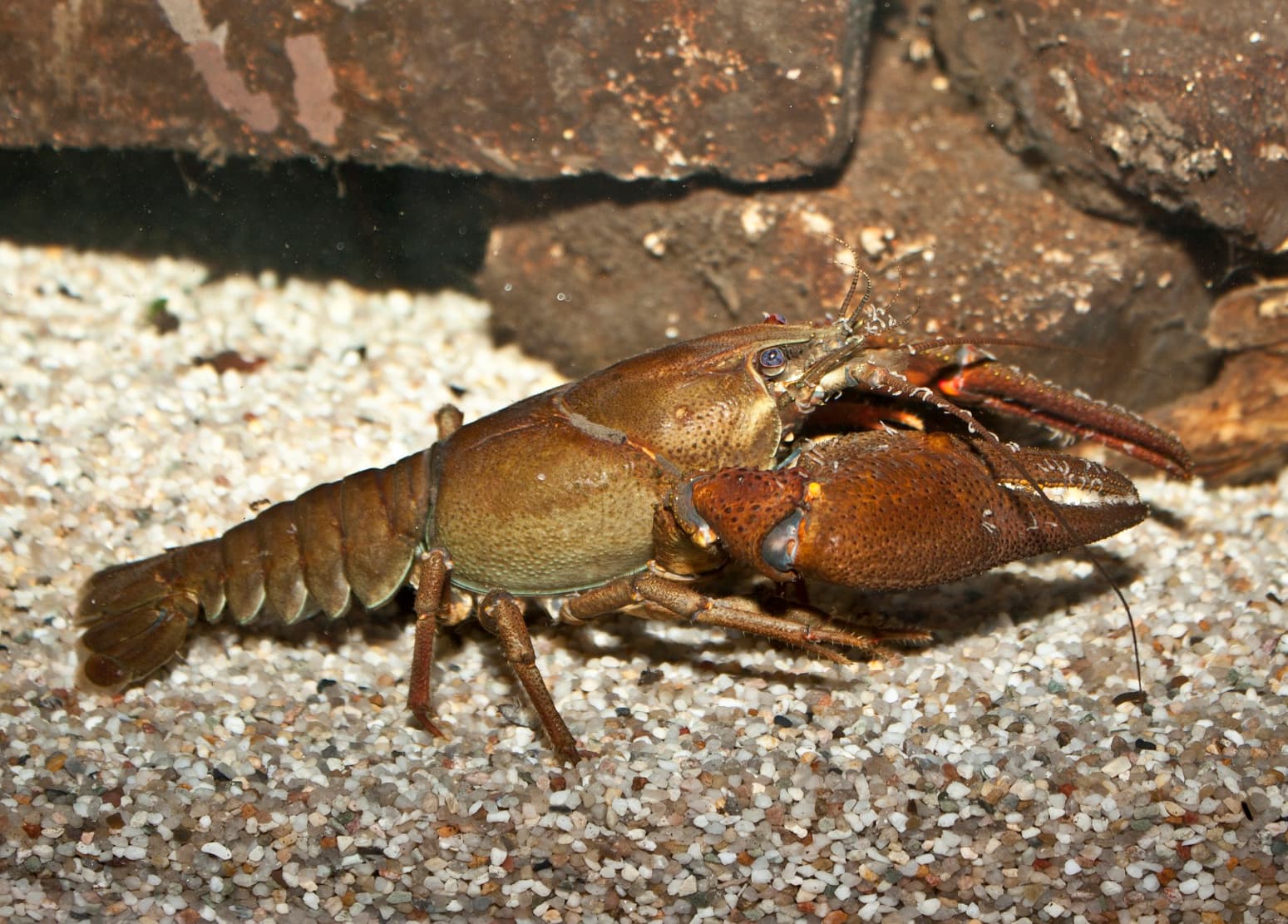
Decapoda spp.
Crayfish
Crayfish appear in official lists for some reservoirs, but they are not a main recreational angling target here. Treat them as ecosystem context and do not keep them without checking rules.
About this fish
Crayfish are a reminder that reservoirs are more than fish. For beginners, respecting the ecosystem and avoiding transfers between dams matters most.
Where to find it
They stay around stones, snags, bank cover, and firmer bottom.
How to identify it
Not a fish: shell, claws, and segmented body.
How to catch it
This wiki does not provide a target crayfish guide: legal methods and rules must be checked separately.
Baits and lures
- not a target species for this guide
Equipment
- no special gear is needed for normal angling; do not use traps without checking rules
- 1.If caught accidentally, release it carefully back to the water.
- 2.Do not move live organisms between reservoirs.
Handling and rules
Not venomous, but claws can pinch. Do not transfer between reservoirs.
Check DFMR rules before any targeted collection or trap use.
Where it lives in this guide
- Lefka ReservoirFreshwaterLefkosia · 35.064° N, 32.838° E
- Xyliatos ReservoirFreshwaterLefkosia · 35.006° N, 33.038° E
- Tamasos ReservoirFreshwaterLefkosia · 35.017° N, 33.248° E
- Lefkara ReservoirFreshwaterLarnaka · 34.894° N, 33.296° E
- Asprokremmos ReservoirFreshwaterPafos · 34.726° N, 32.554° E
- Evretou ReservoirFreshwaterPafos · 34.976° N, 32.473° E
- Achna ReservoirFreshwaterAmmochostos · 35.048° N, 33.803° E
Forecast for Lefka Reservoir
Loading forecast…
What difficulty means
It is not fish size or danger. It means how hard it is to consistently find, trigger, and catch the species in real Cyprus conditions.
Beginner-friendly: simple tackle, clear bites, and less demand for perfect presentation.
Gear. Float rod, feeder, or simple bottom rig; small set of hooks, weights, and bait.
Weather. Best with wind under 18 km/h, moderate UV, and low rain chance.
Requires reading the spot: depth, wind, cover, fish activity, and retrieve speed.
Gear. Bring 2-3 methods, spare leaders, different weights/lures, and unhooking tools.
Weather. Wind at 18-28 km/h affects casting; watch gusts, pressure, and swell.
Hard to catch consistently: the species may be rare, local, seasonal, depth-sensitive, weather-sensitive, or active only in short windows.
Gear. Tackle depends on method and spot. Having options, patience, and spot-reading matters more than one 'correct' rig.
Weather. Watch activity windows: wind, pressure, clarity, water level, current, and light can matter more than the lure.