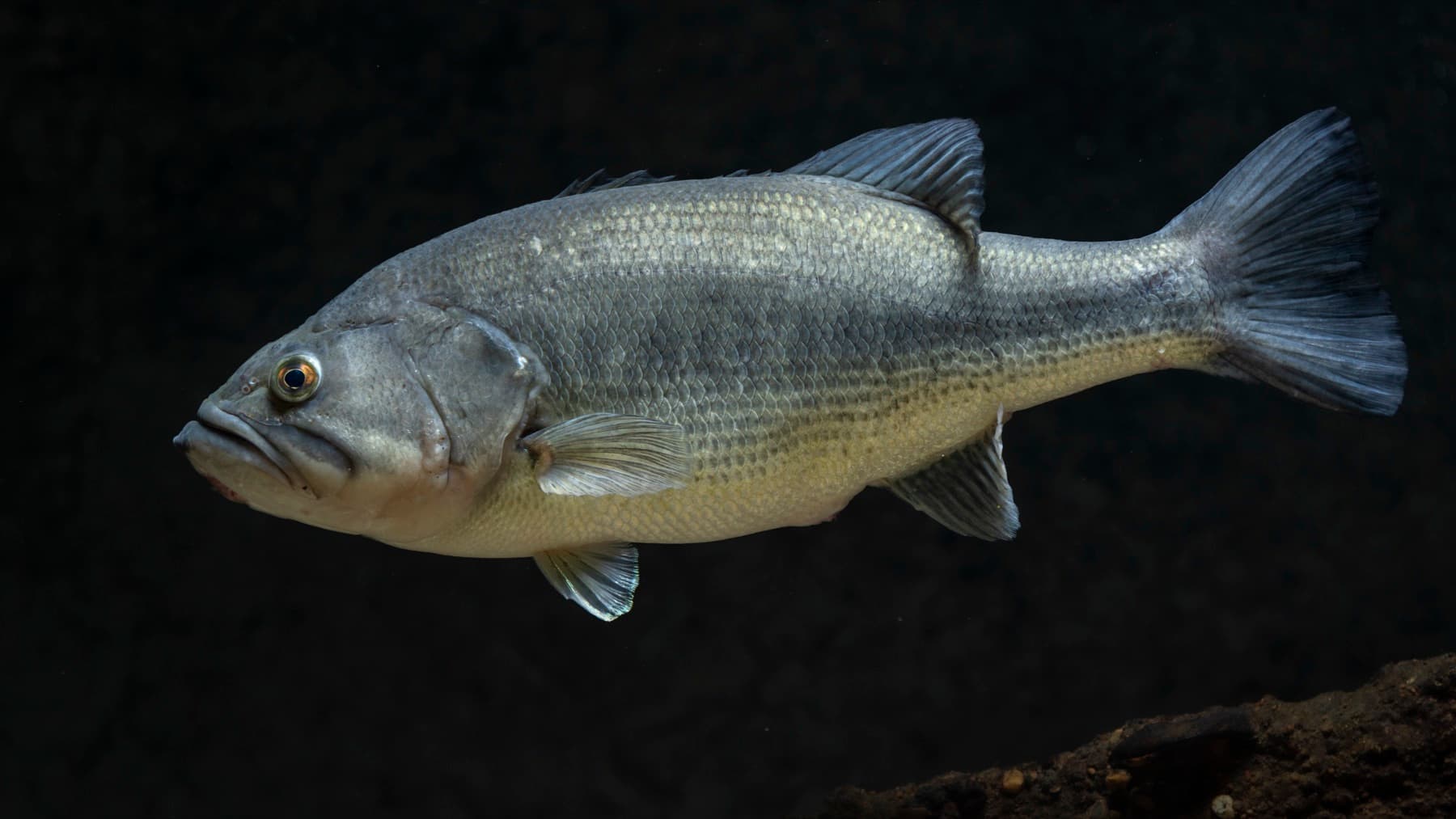
Micropterus salmoides
Largemouth Bass
A key reservoir predator for Cyprus spinning anglers. Bass loves cover, weed edges, rocks, and sharp depth changes.
About this fish
Bass can feel moody: shallow in the morning, deeper at midday, and back onto baitfish in the evening. The angler who reads cover usually beats the one who simply casts farther.
Where to find it
Look around flooded bushes, rocks, dam walls, shade, and places where baitfish stay close to cover.
How to identify it
The mouth reaches behind the eye, the body is greenish, and a broken dark side stripe is often visible.
How to catch it
Start with a 7-10 cm soft plastic on an offset hook or light jig head. Work it slowly along cover with pauses.
Baits and lures
- soft worms
- paddle tails
- small crankbaits
- spinnerbait near weed
Equipment
- light or medium-light spinning rod for small wobblers, soft plastics, and spoons
- line/braid, leader, and several lure weights matched to depth, wind, and snags
- offset hooks, jig heads, and a soft-plastic box
- polarized glasses and long pliers
- 1.Arrive early and fish shade, rocks, and weed edges first.
- 2.Make 3-5 casts from different angles into one promising spot.
- 3.If nothing bites, change speed, depth, or move to the next piece of structure.
Handling and rules
Not venomous. Hold it carefully by the lower jaw, avoid hot rocks, and release quickly if you do not keep it.
Freshwater fishing requires a DFMR license, and the reservoir must be open. Check limits before the trip.
Where it lives in this guide
- Vyzakia ReservoirFreshwaterLefkosia · 35.062° N, 33.027° E
- Palaichori ReservoirFreshwaterLefkosia · 34.928° N, 33.130° E
- Xyliatos ReservoirFreshwaterLefkosia · 35.006° N, 33.038° E
- Tamasos ReservoirFreshwaterLefkosia · 35.017° N, 33.248° E
- Klirou-Akakiou-Malounda ReservoirFreshwaterLefkosia · 35.015° N, 33.173° E
- Germasogeia ReservoirFreshwaterLemesos · 34.744° N, 33.084° E
- Kouris ReservoirFreshwaterLemesos · 34.728° N, 32.918° E
- Dipotamos ReservoirFreshwaterLarnaka · 34.860° N, 33.351° E
- Lefkara ReservoirFreshwaterLarnaka · 34.894° N, 33.296° E
- Kalavasos ReservoirFreshwaterLarnaka · 34.804° N, 33.261° E
- Aradippou ReservoirFreshwaterLarnaka · 34.960° N, 33.580° E
- Asprokremmos ReservoirFreshwaterPafos · 34.726° N, 32.554° E
- Evretou ReservoirFreshwaterPafos · 34.976° N, 32.473° E
- Agia Marina ReservoirFreshwaterPafos · 35.117° N, 32.541° E
- Pomos ReservoirFreshwaterPafos · 35.142° N, 32.577° E
- Kannaviou ReservoirFreshwaterPafos · 34.934° N, 32.593° E
- Achna ReservoirFreshwaterAmmochostos · 35.048° N, 33.803° E
Forecast for Vyzakia Reservoir
Loading forecast…
What difficulty means
It is not fish size or danger. It means how hard it is to consistently find, trigger, and catch the species in real Cyprus conditions.
Beginner-friendly: simple tackle, clear bites, and less demand for perfect presentation.
Gear. Float rod, feeder, or simple bottom rig; small set of hooks, weights, and bait.
Weather. Best with wind under 18 km/h, moderate UV, and low rain chance.
Requires reading the spot: depth, wind, cover, fish activity, and retrieve speed.
Gear. Bring 2-3 methods, spare leaders, different weights/lures, and unhooking tools.
Weather. Wind at 18-28 km/h affects casting; watch gusts, pressure, and swell.
Hard to catch consistently: the species may be rare, local, seasonal, depth-sensitive, weather-sensitive, or active only in short windows.
Gear. Tackle depends on method and spot. Having options, patience, and spot-reading matters more than one 'correct' rig.
Weather. Watch activity windows: wind, pressure, clarity, water level, current, and light can matter more than the lure.